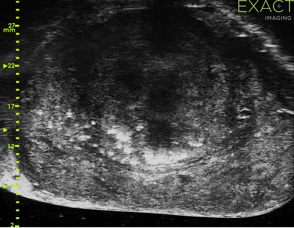
Traditional ultrasound systems operate at 5–9 MHz, allowing the borders of the
prostate to be seen, but without much internal detail. ExactVu™
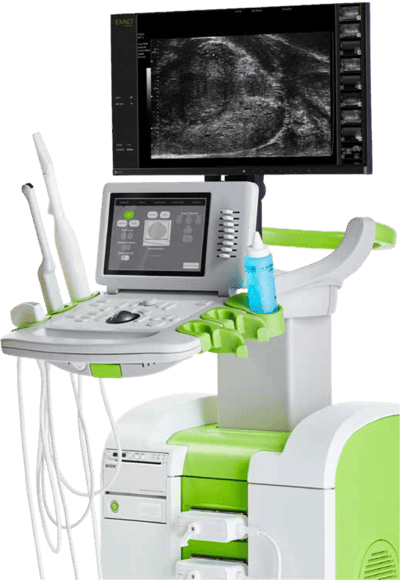
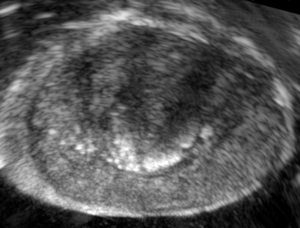
Micro-Ultrasound operates at 29 MHz, delivering 70-micron near-microscopic
resolution, which enables real-time visualization of prostate tissue and ductal
structures with unprecedented clarity.
The result: Real-time imaging that reveals structures previously invisible on
conventional ultrasound.
At each milestone, you’ll receive a certificate of recognition from Exact Imaging. Completion of Level 4 recognizes you as an ExactVu Micro-Ultrasound Expert, with formal certification and acknowledgment across Exact Imaging’s social media channels.
Why Frequency Matters
Ultrasound frequency relates to the relationship between image clarity and
depth. Higher frequencies produce sharper, more detailed image, but the
depth of penetration is reduced. While lower frequencies penetrate deeper
but produced less detailed images.
The engineering breakthrough that makes ExactVu possible is the ability to
image deeply with higher frequencies allowing unprecedented resolution for
even the largest prostates.

High-frequency sound waves
Shorter wavelengths
Optimized for prostate imaging depth
3x higher resolution (~70 microns)
Lower frequency sound waves
Longer wavelengths
Greater penetration depth
Limited resolution
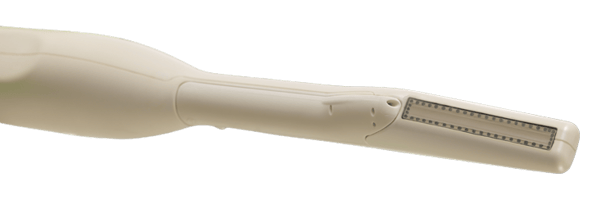
Image quality in ultrasound isn’t just about frequency, it’s also about crystal spacing within the transducer. Tighter crystal spacing reduces artifacts andallows the beam profile to be more precisely controlled leading to improvements in resolution and signal to noise ratio.
| ExactVu Micro-Ultrasound Transducer | Conventional System Transducers |
| • Tightly spaced transducer crystals | • Wider spacing between transducer crystals |
| • Higher element density | • Lower element density |
| • Thinner, more focused beams | • Thicker ultrasound beams |
| • Increased sampling precision | • Reduced image sharpness |

What This Means Clinically
The combination of 29 MHz frequency and dense crystal spacing
allows clinicians to:
Visualize prostate tissue at near-microscopic resolution
Clearly Identify suspicious regions during the procedure
Perform targeted biopsies in real-time, with or without MRI
Reduce reliance on cognitive or software-based MRI fusion
Key Advantage:
See
Characterize
Target
Treat
all in a single workflow.